Ankle Proprioception Therapy
Ankle Proprioception Therapy is a physiotherapy rehabilitation approach designed to improve the ankle's ability to sense its position, movement, and loading during standing and physical activity. Proprioception helps the body automatically respond to changes in balance and movement, allowing the ankle and surrounding muscles to make quick adjustments when walking, running, stepping, or changing direction.
After an ankle sprain, injury, surgery, prolonged immobilization, or periods of reduced activity, proprioceptive control may become impaired. This can contribute to reduced balance, ankle instability, and difficulty controlling the foot during weight-bearing activities. Ankle proprioception therapy uses progressive exercises to restore coordination, stability, and confidence in ankle movement.
How Ankle Proprioception Therapy Works
The physiotherapist begins by assessing ankle mobility, strength, balance, stability, walking pattern, and the ability to control the affected leg during different movements.
Training may begin with simple weight-shifting and standing exercises and gradually progress to more challenging activities. The exercises are designed to make the ankle and lower limb respond to controlled changes in position, surface, direction, and movement.
As control improves, exercises can progress from double-leg activities to single-leg balance, dynamic movements, unstable surfaces, stepping tasks, and sport-specific drills.
Conditions That May Benefit
Depending on the clinical assessment, Ankle Proprioception Therapy may be incorporated into rehabilitation for:
- Ankle sprains
- Recurrent ankle instability
- Ankle weakness
- Reduced balance following injury
- Post-surgical ankle rehabilitation
- Stiffness following immobilization
- Sports-related ankle injuries
- Difficulty with single-leg balance
- Reduced lower-limb coordination
- Gait and movement-control problems
Benefits of Ankle Proprioception Therapy
When appropriately prescribed, proprioception training may help:
- Improve ankle stability
- Improve balance and coordination
- Enhance awareness of ankle position
- Improve lower-limb control
- Increase confidence during weight-bearing activities
- Improve movement during walking and running
- Support recovery following ankle injuries
- Prepare the ankle for higher-level physical activities
- Help improve control during changes in direction
Better proprioceptive control can help the ankle respond more effectively when the foot encounters unexpected changes in surface or position.
Common Ankle Proprioception Exercises
Your physiotherapist may introduce exercises according to your rehabilitation stage.
Single-Leg Standing:
Standing on the affected leg challenges the ankle and surrounding muscles to maintain stability.
Weight-Shifting Exercises:
Controlled movement of body weight in different directions helps develop ankle control.
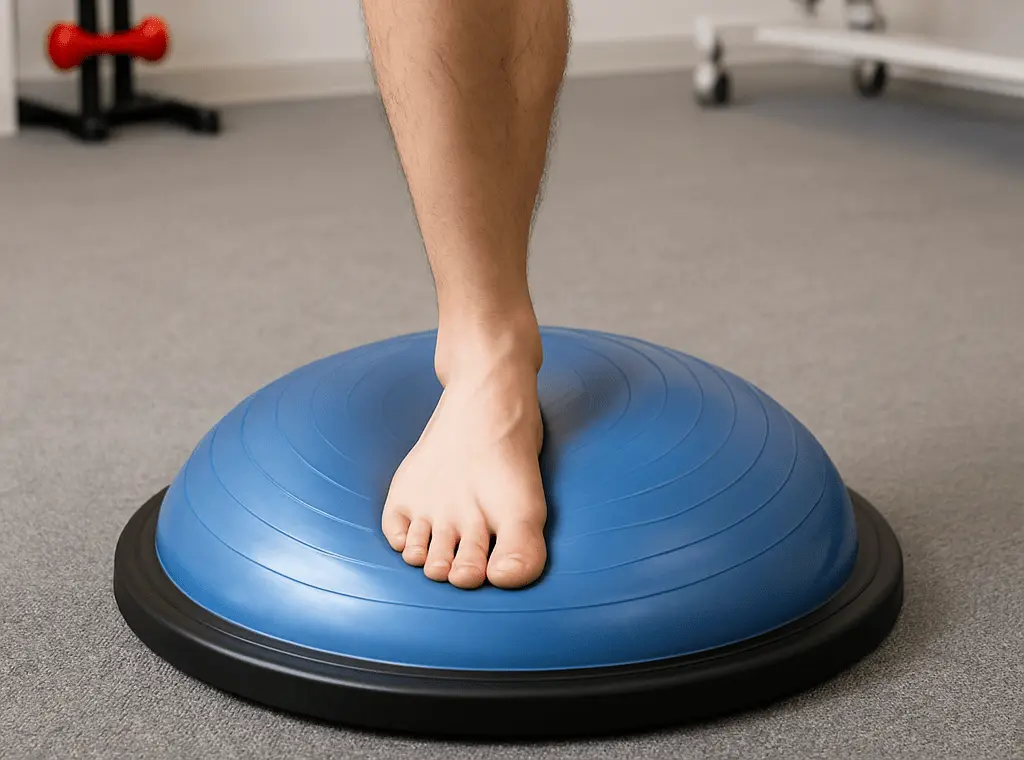
Balance Pad Exercises:
Appropriate unstable or compliant surfaces can increase the challenge to balance and proprioception.
Heel-to-Toe Walking:
Controlled walking along a narrow path can challenge balance and coordination.
Step and Reach Exercises:
Standing on one leg while reaching or moving the other leg encourages dynamic ankle control.
Hopping and Landing Drills:
For suitable patients and later rehabilitation stages, controlled jumping and landing can prepare the ankle for higher physical demands.
What to Expect During Treatment
Your physiotherapist will first assess your balance, ankle strength, range of motion, and ability to control the affected leg.
Early exercises may be performed while holding onto a stable surface for support. As your balance improves, the amount of support can be reduced and the exercises can become progressively more challenging.
Your therapist may change the:
- Surface
- Base of support
- Exercise speed
- Direction of movement
- Resistance
- Visual conditions
- Single-leg or double-leg position
- Functional complexity
All exercises are progressed according to your ability and safety.
Proprioception After Ankle Sprain
An ankle sprain can affect the structures responsible for joint stability and movement awareness. Even after pain and swelling decrease, some people may continue to experience weakness or a feeling that the ankle is unstable.
Proprioception exercises can therefore be incorporated into rehabilitation alongside ankle strengthening, mobility exercises, balance training, and progressive weight-bearing activities.
Ankle Proprioception for Athletes
Athletes need rapid ankle control during running, jumping, landing, cutting, and changes of direction. Proprioceptive rehabilitation can progress from basic balance exercises to more dynamic activities.
Advanced rehabilitation may include single-leg landing, hopping, agility drills, directional changes, acceleration and deceleration exercises, and sport-specific movements.
The intensity is gradually increased so the ankle can develop the strength and control needed for the demands of the sport.
Ankle Proprioception and Gait Training
Proprioceptive control contributes to normal walking because the ankle must continuously adjust to changes in body position and the walking surface.
For patients with altered walking patterns, proprioception exercises may be combined with gait retraining, ankle strengthening, foot exercises, and balance training to improve lower-limb coordination and functional movement.
Personalized Ankle Proprioception Therapy
The appropriate exercises depend on the type of ankle problem, strength, mobility, balance ability, and stage of recovery. Exercises should therefore be progressed gradually rather than introducing advanced balance challenges too early.
At our physiotherapy clinic, Ankle Proprioception Therapy is tailored to your individual condition and rehabilitation goals. Our physiotherapists use progressive balance and movement exercises to improve ankle stability, coordination, body awareness, and functional control, helping you progress safely toward walking, exercise, work, and sports activities.